
Lower Cost, Higher Quality Eucalyptus Crane Mats For Windpower
Lower Cost, Higher Quality Eucalyptus Crane Mats For Wind Power Projects – was revised on January 15, 2026
Originally contributed to WindPower Engineering & Development, June 16, 2020. Updated and expanded with 2026 market data and analysis.
Three-Point Summary:
-
Eucalyptus timber mats for windpower deliver 264% more bending strength than mixed hardwood #2 at 67% lower cost per PSI
-
Wind turbine installations demand stronger crane mats as turbines grow larger and heavier with each generation
-
Plantation-grown Eucalyptus solves the declining quality crisis in domestic mat supply. And reduces total cost of ownership by 59%
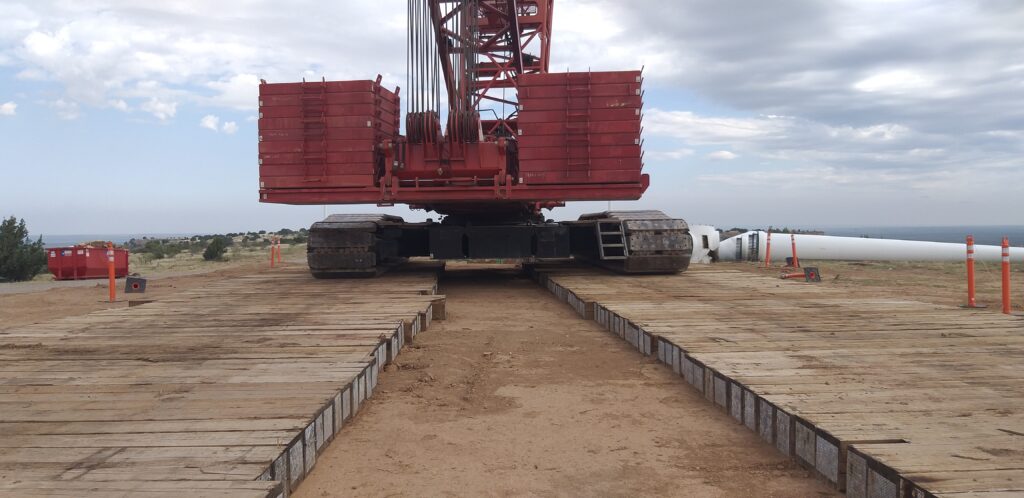
Wind power projects face a critical challenge with crane mats. Eucalyptus crane mats for wind power installations deliver the solution contractors need.
Crane mat quality continues declining while mat prices climb. Additionally, 12-inch crane mats become harder to source each year.
Meanwhile, wind power technology advances rapidly. Heavier turbines and taller towers require bigger cranes and stronger ground protection. Therefore, contractors need reliable mat solutions that deliver consistent performance.
World Forest Group set out to solve this problem. We developed Eucalyptus crane mats for windpower that match contractor expectations. Familiar timber mat performance and superior materials and proven technology.
Market Changes: 2020 → 2026
How Declining Timber Quality Changed The Economics
2020 Market Conditions
✓ Mixed hardwood #1 grade available
✓ Moderate mat prices
✓ Reasonable cost per PSI
6 Years of Decline
2026 Market Conditions
✗ Only #2 and #3 grade timbers
✗ Prices increased 40%+
✗ Cost per PSI soared 3x
The Result:
177%
Higher cost per PSI
for mixed hardwood
66%
Savings with Eucalyptus
vs 2026 mixed hardwood
The Growing Crisis In Crane Mat Quality
Historically, advancing industries consume raw materials faster than nature replenishes them. So, both abundance and quality decline over time. The timber matting industry faces exactly this challenge today.
In 1664, John Evelyn warned Britain about industrial expansion depleting timber stocks. Over 100 years, timber suitable for the British Navy shrunk by 90%. Britain couldn’t grow oak fast enough. Bingo! America’s abundant forests replaced the missing raw material.
Fast forward 400+ years. The domestic timber industry mirrors John Evelyn’s Britain. High-quality oak has been mostly harvested. Tree diameters shrunk. And, environmental awareness restricts access to remaining quality stands.
The domestic matting business now relies on lower-quality logs to produce products that contractors require to be high-quality. This creates a fundamental problem.
What Changed Since The Original 2020 Article on Eucalyptus Crane Mats for Windpower
We noted declining mat quality and rising prices in the WindPower Engineering article in June 2020. Not surprisingly, those trends accelerated dramatically over the past six years.
Two critical market shifts occurred between 2020 and 2026:
First, mixed hardwood mat prices increased substantially. Supply constraints and inflation pushed costs higher while quality continued falling.
Second, timber grades dropped significantly. What contractors could source in 2019—predominantly #1 grade timbers—became almost impossible to find. Today’s market offers primarily #2 and #3 grade timbers.
These weaker timbers mean cost per unit strength soared. The economics shifted dramatically against mixed hardwood mats. Consequently, the case for Eucalyptus crane mats for windpower strengthened considerably.
Material Science: Why Eucalyptus Crane Mats Work For Wind Power
World Forest Group’s 30+ year experience centers on sourcing wood species with superior working characteristics from sustainably managed forests. Additionally, we focus on creating industrial products that fit contractor requirements.
The best crane mats use tropical hardwoods. For example, Ekki represents a well-known superior African species. However, most native tropical hardwoods cost significantly more than contractors accept except for extreme lift requirements.
Eucalyptus displays exceptional strength characteristics. Moreover, it grows on plantations worldwide. Therefore, Eucalyptus costs far less than rainforest tropical hardwoods. Using plantation-grown Eucalyptus as a replacement for scarce high-quality U.S. oak solves the materials challenge.
Let’s examine the actual numbers.
Design Strength Comparison: Eucalyptus Vs Mixed Hardwood
Understanding how Eucalyptus compares with mixed hardwoods regarding strength reveals measurable advantages. The data comes from authoritative industry sources.
Estimated price 18’x4’x12″ mat CIP Houston (2026):
Eucalyptus: $1200
Mixed Hardwood #2: $975
| Mat Type | Bending Strength Fb (PSI) | Shear Strength Fv (PSI) | Compression Perpendicular Fc (PSI) | Modulus of Elasticity E (PSI) |
|---|---|---|---|---|
| Eucalyptus | 2000 | 265 | 970 | 1,300,000 |
| Mixed Hardwoods #2 | 550 | 200 | 415 | 900,000 |
| Eucalyptus Stronger By | 264% | 32.5% | 134% | 44% |
Eucalyptus Delivers 264% More Bending Strength
Bending Strength Comparison (PSI)
264% Stronger
Eucalyptus vs Mixed Hardwood #2
These standardized data tell a clear strength story. Eucalyptus design value bending strength reaches 2000 PSI compared to only 550 PSI for Mixed Hardwood #2 timbers. In other words, Eucalyptus delivers 264% more bending strength.
Starting around 2018, mixed hardwood #2 timbers gradually replaced #1 grade timbers in most markets. Consequently, mixed hardwood mat performance and lifespan declined noticeably. Therefore, understanding actual timber grades becomes critical for accurate cost projections.
Cost Per Unit Strength: The Real Economics
Purchase price alone doesn’t reveal true value. Instead, cost per unit of actual strength shows which material delivers better economics. The analysis proves compelling for Eucalyptus.
| Mat Type | US$ per Bending Strength (Fb) | US$ per Shear Strength (Fv) | US$ per Compression Perpendicular (Fc) | US$ per Modulus of Elasticity (E) |
|---|---|---|---|---|
| Eucalyptus | $0.60 | $4.53 | $1.24 | $0.00092 |
| Mixed Hardwoods #2 | $1.77 | $4.88 | $2.35 | $0.00108 |
| Eucalyptus Advantage | 66% lower | 7% lower | 47% lower | 15% lower |
Lower cost per unit strength is better. Rough cost per unit strength (PSI) for various species, new 12″ crane mats, Houston 2026. Illustration only.
Cost per unit strength examines true value rather than simple sticker price. For example, Eucalyptus costs 66% less per unit of bending strength despite the $225 higher initial mat price. Additionally, compression strength costs 47% less per PSI with Eucalyptus compared to mixed hardwoods.
How Declining Timber Grades Changed The Economics
Between 2020 and 2026, the shift from #1 to #2 grade timbers in mixed hardwood mats fundamentally altered cost per unit strength calculations. #2 grade timbers deliver significantly lower strength ratings. Meanwhile, prices increased.
Consequently, the cost per PSI gap between Eucalyptus and mixed hardwoods widened dramatically. What showed moderate advantage in 2020 became overwhelming economic superiority by 2026.
66% Lower Cost Per Unit Strength
Cost per PSI of Bending Strength (12" Crane Mats)
$1,200 mat
$975 mat
Save 66% Per PSI
Eucalyptus costs $0.60 per PSI vs $1.77 for Mixed Hardwood #2
Technology Solutions For Better Crane Mats
Material science provides one path to better crane mats. Technology offers another complementary approach. World Forest Group applies both simultaneously. Eucalyptus crane mats for windpower is the result.
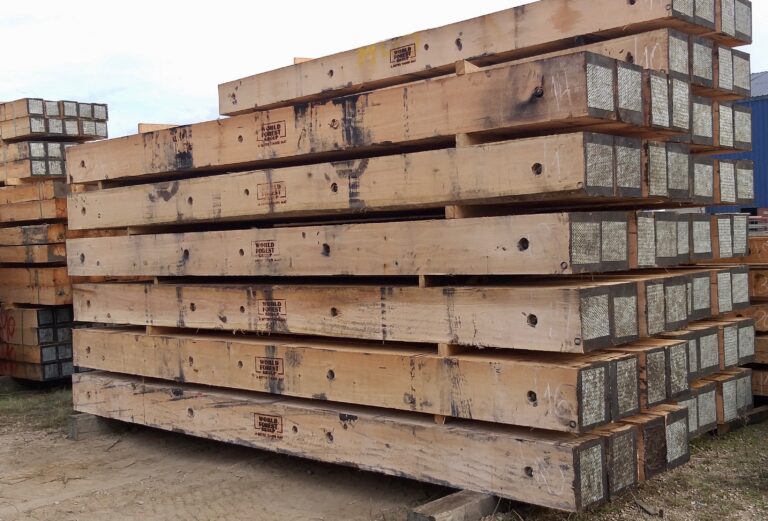
Square Timber Construction
We cut square timbers instead of rounded edges for four critical reasons:
First, buyers pay for wood, not bark or air. Square timbers maximize usable material.
Second, standardization matters. Using square Eucalyptus timbers means every mat performs identically with consistent working characteristics. Additionally, crews work on level surfaces, improving safety.
Third, flat surfaces reduce wear and tear from machines operating on the mats.
Fourth, square timbers mean bolts grip solidly without gaps or irregularities.
We can produce square timbers because we source larger logs and cut specifically for crane mats rather than grade lumber. Moreover, we choose the more costly square timber specifically for manufacturing quality.
End-Plate Technology
Every mat producer applies paint or end-sealant to prevent cracking and splitting at timber ends. World Forest Group follows this practice. However, we add metal end-plates to timber ends.
End plates represent forest industry standard for all large timbers. Look at trusses, large post and beam construction, and other structural timbers. You’ll typically find end-plates protecting the wood.
This proven technology extends mat lifespan significantly. Therefore, total cost of ownership decreases while performance reliability increases.
Right-Sizing Eucalyptus Crane Mats For Windpower Applications
Wind turbine installations present varying load requirements. Consequently, matching mat strength to actual lift demands optimizes both performance and cost.
For example, many installations don’t require maximum capacity. A 10-inch Eucalyptus mat delivers equivalent or superior performance to a 12-inch mixed hardwood mat for moderate lifts. The cost savings prove substantial.
For heavy lifts currently using two 12-inch mixed hardwood mats, one 10-inch Eucalyptus mats often provide sufficient capacity. Again, contractors save money while maintaining required safety margins.
Conversely, lighter applications might use 8-inch Eucalyptus mats for windpower (roughly equivalent to 11-inch to 14-inch mixed hardwood) where loads don’t demand full 12-inch capacity. Walking mats are one application.
This strength-based specification approach lets contractors optimize mat purchases. Consequently, projects use appropriate materials without overbuying unnecessarily.
Monthly Depreciation: Total Cost Of Ownership Analysis
Purchase price tells only part of the ownership story. Monthly depreciation reveals complete economic impact by combining acquisition cost with expected service life.
Service Life Comparison
-
Eucalyptus lifespan: 60 months (5 years)
-
Mixed Hardwood #2 lifespan: 21 months (1.75 years)
Monthly Depreciation Analysis
| Mat Type | Purchase Price | Expected Lifespan | Monthly Depreciation |
|---|---|---|---|
| Eucalyptus 18’x4’x12″ | $1,200 | 60 months | $20.00 |
| Mixed Hardwood #2 18’x4’x12″ | $975 | 21 months | $46.43 |
| Eucalyptus Advantage | +23% higher initial | +186% longer life | 57% lower monthly cost |
These numbers demonstrate powerful economics. Although Eucalyptus costs $225 more initially (23% premium), the mat lasts nearly three times longer. As a result, monthly depreciation drops by 57%, from $46.43 to just $20.00.
For a contractor purchasing 1000 mats:
-
Eucalyptus: $1,200,000 initial investment / $20,000 monthly depreciation
-
Mixed Hardwood #2: $975,000 initial investment / $46,430 monthly depreciation
After just 9 months, lower monthly depreciation offsets the higher Eucalyptus purchase price. Moreover, Eucalyptus crane mats for windpower continue delivering value for 51 additional months. Meanwhile, mixed hardwood mats require complete replacement at 21 months.
57% Lower Monthly Depreciation
Total Cost of Ownership (18'x4'x12" crane mats)
$1,200 / 60 months
$975 / 21 months
Eucalyptus
Purchase: $1,200
Lifespan: 60 months
Mixed Hardwood #2
Purchase: $975
Lifespan: 21 months
Save $26.43 Per Mat Per Month
That's a 57% reduction in monthly ownership cost
Transportation Economics: More Mats Per Truck
Eucalyptus delivers superior strength at lighter weight than mixed hardwoods. Consequently, more mats fit on each truck. This reduces freight costs per mat significantly.
Over a mat’s service life, freight becomes a substantial component of total cost of ownership. Therefore, the weight-to-strength ratio matters considerably for projects requiring repeated mat movements.
For example, heavy species like Ekki offer excellent strength but poor freight economics due to weight. Eucalyptus provides the optimal balance—exceptional strength with reasonable weight for efficient transportation.
Sustainability And Wind Energy Alignment
Wind power projects prioritize environmental responsibility. Plantation-grown Eucalyptus aligns with these sustainability values. The timber comes from managed forests rather than old-growth harvesting.
Additionally, faster-growing plantation timber regenerates more quickly than slow-growth hardwood species. This renewable approach supports the environmental mission driving wind energy expansion.
Therefore, choosing Eucalyptus crane mats reinforces project sustainability goals while delivering superior technical performance and economics.
Why Stronger Crane Mats Matter For Wind Power’s Future
Wind turbine technology continues advancing rapidly. Each generation brings taller towers, longer blades, and heavier nacelles. Consequently, crane capacity requirements increase steadily.
Bigger cranes demand stronger ground protection. Mixed hardwood #2 mats struggle to meet these escalating demands. Moreover, declining timber quality means future mixed hardwood mats will perform even worse than today’s versions.
Eucalyptus crane mats provide the strength margin wind power projects require. Engineers can specify with confidence knowing material properties remain consistent and predictable. Additionally, the superior strength allows right-sizing applications to optimize both performance and cost.
Conclusion: Material Science And Technology Create Better Solutions
The wind power industry demonstrates how continuous innovation solves technical challenges. World Forest Group applies that same principle to crane matting.
By combining material science (superior plantation-grown Eucalyptus) with proven technology (square timbers and end-plates), we created crane mats that outperform traditional mixed hardwood alternatives.
The data proves compelling:
-
264% greater bending strength
-
66% lower cost per unit of strength
-
57% reduced monthly depreciation
-
186% longer service life
Stronger crane mats become increasingly critical as wind power technology advances. Eucalyptus timber mats deliver the performance, reliability, and economics wind energy projects demand.
Attribution & Additional Resources
This article was originally contributed to WindPower Engineering & Development in June 2020 and has been updated and expanded with 2026 market data and analysis.
Read the original publication: Discovering Lower Cost, Higher Quality And More Sustainable Crane Mats – WindPower Engineering & Development
Download the original 2020 article (PDF): WindPower Engineering Article PDF
Learn more about Eucalyptus timber mat basics: Eucalyptus Timber Mats Essentials
Explore additional resources: World Forest Group Learning Center
Get Started With Eucalyptus Crane Mats For Your Wind Power Project
Wind turbine installations demand reliable ground protection that matches advancing technology requirements. Contact us.