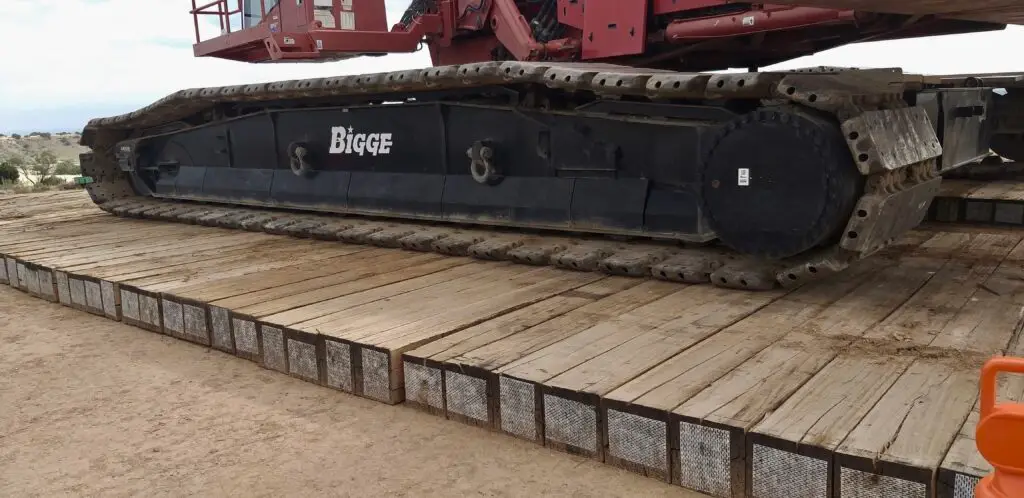
Eucalyptus Timber Mat Strength Compared To Mixed Hardwood Options
Revised January 2026
Strength is the basis of performance. Eucalyptus timber mats deliver superior bending and compression strength compared to mixed hardwood alternatives across all material grades, enabling contractors to specify thinner profiles that reduce transportation costs while maintaining equivalent load capacity. Understanding timber grade specifications and allowable design strength helps equipment managers make data-driven purchasing decisions for engineered lifts, lease fleets, and challenging jobsite conditions. Material strength directly impacts service life and total cost of ownership.
Why Material Strength Matters For Ground Protection Equipment
Stronger materials yield superior performance in real-world applications. Material strength becomes especially critical in engineered lifts such as wind turbine crane operations and in situations involving repeated loading cycles on the same equipment.
Predicting mat longevity requires understanding structural performance under stress. Stronger materials generally deliver longer service life, which proves particularly important for lease fleet operators managing equipment across multiple projects and contractors seeking to lower total cost of ownership.
Ground bearing conditions vary significantly across jobsites. Allowable design strength calculations determine what machinery and loads specific mats can safely support under different soil conditions without compromising equipment protection or operator safety.
Eucalyptus Strength Advantages Across Material Properties
Design Strength Comparison
Eucalyptus demonstrates measurably higher performance than traditional mixed hardwood materials across critical structural properties. Standardized testing protocols document these performance differences.
| Wood | Bending (psi) | Shear (psi) | Compression (psi) |
|---|---|---|---|
| Eucalyptus | 2000 | 265 | 970 |
| Mixed Hardwood #1 timbers | 1000 | 200 | 415 |
| Mixed Hardwood #2 timbers | 550 | 200 | 415 |
Clear sample measurements show Eucalyptus at 2000 PSI bending strength versus 1000 PSI for Mixed Hardwood Select grade timbers. Mixed Hardwood #2 grade drops to 550 PSI bending strength, demonstrating how timber grade dramatically affects structural performance even within the same species category.
Shear strength reaches 265 PSI for Eucalyptus compared to 200 PSI for mixed species across grades. Compression strength follows similar patterns with Eucalyptus at 970 PSI versus 415 PSI for mixed hardwood alternatives.
Understanding Design Strength Versus Clear Sample Measurements
Material strength depends on both species and material grade. These factors combine to determine real-world equipment performance under field conditions.
Mat users need allowable design strength rather than clear sample material strength from laboratory testing. If you are looking for material strength on manufacturers’ sites make sure you’re getting design specs not clear sample specs.
This distinction proves critical because design strength accounts for natural material variation, manufacturing tolerances, and safety factors required for reliable equipment performance. Clear sample testing provides theoretical maximum values while design strength delivers practical working limits for purchasing decisions.
Timber Grading Standards And Specifications
Select Structural represents the highest timber grade in the United States for dimensions 5 inches by 5 inches and larger. Timbers meeting this size threshold follow specific grading standards that determine allowable design values.
The American Wood Council’s National Design Specification provides standardized values for common mat materials. Mixed oak classifications under AWC NDS show significant variation across grades. Select Structural mixed oak rates at 1250 PSI bending strength, while Grade Number 1 mixed oak drops to 1000 PSI and Grade Number 2 falls to 575 PSI.
Material grade dramatically affects equipment performance and service life. Contractors receiving Grade Number 1 or Grade Number 2 timbers instead of Select Structural should adjust thickness specifications accordingly to maintain required load capacity.
Species not listed in AWC NDS specifications require interpolation from alternative data sources. Poplar and other materials sometimes used for temporary access mats need careful engineering analysis based on available strength documentation.
[More details → https://eucmat.is/stronger]
Practical Field Applications Of Superior Eucalyptus Strength
Specifying By Strength Rather Than Thickness Alone
Consider specifying mat strength requirements rather than relying solely on dimensional specifications. A 6.75-inch thick Eucalyptus mat provides equivalent bending strength to an 8-inch Select Structural mixed oak mat, delivering immediate transportation cost savings by increasing loads per truck. If you are getting #2 mixed hardwood timbers then a 6.75″ Eucalyptus is similar to a 12″ mixed hardwood mat!
Contractors receiving Grade Number 1 or Grade Number 2 mixed hardwood timbers find that 5-inch to 6-inch Eucalyptus profiles match or exceed the structural performance of thicker traditional alternatives. Verifying actual timber grade prevents overbuilding and unnecessary material expense.
Engineered Lifts And Challenging Soil Conditions
Engineering lift operations or working on particularly poor soils often requires double-layering mixed hardwood mats to achieve required load distribution. Single Eucalyptus mats can sometimes replace two mixed hardwood mats in these scenarios while maintaining equivalent ground protection and simplifying logistics.
Transmission Line And Utility Construction
Transmission work typically requires 4-inch to 5-inch mat thickness given typical equipment loads and access requirements. Eucalyptus strength advantages allow contractors to optimize thickness specifications for specific machinery weights and ground conditions without compromising safety margins.
Check out How to Destroy a Eucalyptus Mat for strength performance against very heavy concrete truck loading. These real-world tests validate engineering calculations under actual field conditions.
Solar Project Applications
Solar construction machinery weights suit 4-inch thick Eucalyptus mats that provide equivalent strength to approximately 8-inch mixed hardwood alternatives. This optimization reduces material costs and transportation requirements without compromising equipment protection or operator safety.
Laminated Mat Comparisons
Contractors using three-ply bolted or glue-line laminated mats find that approximately 4-inch Eucalyptus profiles roughly equal five-ply 6 7/8-inch laminated alternatives in structural performance. Visual comparisons help clarify these equivalencies for purchasing decisions.
The engineering is a little odd. Contact us for detailed explanations.
Material Science Behind Eucalyptus Strength Performance
Eucalyptus species evolved in challenging environments that selected for rot, wind and fire resistance. These natural adaptations translate directly to superior mechanical properties compared to temperate hardwood species commonly used in traditional mat construction.
Density correlates strongly with structural performance across all wood species. It’s a linear relationship. Some species are heavier and less strong. Other species are lighter and stronger.
Our Eucalyptus species happens to be lighter and stronger. That’s a plus for saving on freight.
Fiber orientation and cellular structure determine how materials respond to stress and repeated loading cycles. Plantation Eucalyptus demonstrates more uniform fiber distribution that resists splitting and maintains structural integrity even after extended service in demanding applications.
Ready to specify stronger ground protection that reduces your total cost of ownership? Contact our technical team for assistance with mat selection, engineering suggestions, and delivery logistics tailored to your specific project requirements.