
Cost Per Unit Strength Timber Mats: Right-Sizing Your Mat Investment
Cost Per Unit Strength Timber Mats: Right-Sizing Your Mat Investment – was revised on January 14, 2026
This is Part 1 of a three-part series on right-sizing timber mat purchases using strength-based analysis.
-
Cost per unit strength timber mats analysis reveals better value than comparing price alone.
-
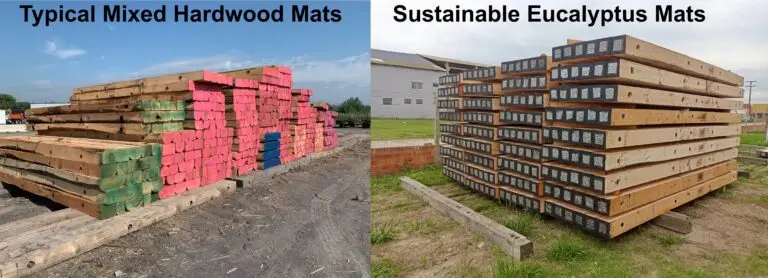
Eucalyptus timber mats cost $0.33/psi for bending strength versus mixed hardwood at $1.00/psi.
-
Stronger mats allow contractors to use fewer, thinner mats while maintaining ground-bearing capacity and safety.
When mat prices drop but quality follows, contractors face a hidden cost trap. The cost per unit strength timber mats approach offers a smarter way to evaluate mat investments, especially when budgets tighten and every dollar counts.
The Mat Purchasing Dilemma
Tariff disruptions, volatile markets, and economic uncertainty push contractors to find cost savings wherever possible. Mat purchases are an obvious target. However, dropping mat prices often come with a catch.
Log prices remain relatively stable regardless of market conditions. When mat manufacturers cut prices, quality usually suffers through softer wood species, smaller timbers, more defects, or purchasing used mats with unknown history.
The question becomes: is there a way to reduce mat costs without sacrificing quality or safety?
Cost Per Unit Strength: A Better Comparison Method
Traditional mat purchasing focuses on price per mat or price per square foot. Cost per unit strength timber mats analysis adds a critical dimension: how much load-carrying capacity you get for each dollar spent.
The math is straightforward. Take the mat price and divide by its strength properties (bending strength, shear strength, or compression strength depending on application). The result shows the true cost of the performance you’re buying.
For example, using bending strength as the comparison metric:
-
Eucalyptus cost per unit bending strength: $0.33/psi ($650/mat and 2000 PSI)
-
Mixed hardwood cost per unit bending strength: $1.00/psi ($550/mat and 550 PSI)
Eucalyptus delivers about 200 percent more strength per dollar than typical mixed hardwood alternatives.
Why Eucalyptus Changes The Value Equation
Eucalyptus timber mats from managed plantations offer superior strength characteristics compared to mixed domestic hardwoods. According to the Mobile Crane Support Handbook by crane expert David Duerr PE, eucalyptus provides:
-
Bending strength: 2,000 psi
-
Shear strength: 265 psi
-
Compression perpendicular to grain: 970 psi
-
Modulus of elasticity: 1,300,000 psi
Compare these to the American Wood Council National Design Specifications for #2 timbers. These higher strength values translate directly into better cost per unit strength timber mats performance. Additionally, eucalyptus is lighter than oak or hickory, which means lower freight costs and easier handling.
The combination of greater strength and lighter weight creates opportunities to reduce total mat system costs through fewer mats, thinner mat profiles, or both.
From Theory To Practice: Strength-Adjusted Mat Selection
When you analyze cost per unit strength timber mats instead of just price, new mat selection strategies emerge:
Replace thick mixed hardwood with thinner eucalyptus: A single 12-inch eucalyptus mat can often replace two layers of 12-inch mixed hardwood mats while meeting the same load requirements.
Use fewer mats for the same coverage: Higher capacity per mat means fewer mats needed to support cranes, equipment, or access roads.
Extend mat life: Stronger wood resists crushing, splitting, and fastener pull-through, which extends useful life and reduces replacement frequency.
These strategies are explored in detail in Part 2: Specific Solutions and Part 3: Backup Engineering and Finance Data of this series.
Next Steps: Applying Cost Per Unit Strength Analysis
Cost per unit strength timber mats analysis works best when you:
-
Know your actual ground-bearing requirements based on equipment weight, soil conditions, and load distribution
-
Compare mats using documented strength properties from testing or published engineering data
-
Consider total cost of ownership including freight, handling, and expected mat life
-
Work with suppliers who can provide engineering support and strength documentation
For contractors ready to move beyond simple price comparisons, cost per unit strength offers a more accurate way to evaluate mat investments and identify genuine value.
To explore specific applications and cost savings examples, see Part 2: Specific Solutions.
Ready to analyze your mat requirements using strength-based methods? Contact World Forest Group at or request a quote to discuss your project.