
Is A Thinner Mat The Future Of Matting? – was revised on December 30, 2025
Why Is A Thinner Mat the Future of Matting?
When this article was first written, diesel fuel hovered near $5.00 dollars per gallon in the United States, driven by the 2022 energy spike. Diesel prices have eased since then, but they still sit well above long‑term historical averages, and freight remains one of the largest line items in matting programs.
At the same time, flatbed rates have trended lower, hardwood mills have shifted more production toward lower quality species and grades, and good mixed hardwood logs suitable for conventional mats have become harder to find. Against that backdrop, it is natural to ask whether thinner, strength‑adjusted mats—especially Eucalyptus timber mats—are the future of matting.
In a sense, a thinner Eucalyptus timber mat can confer many of the same advantages as a thinner composite mat with similar lifespan on a dollar/useful lifespan basis. That’s one reason why a thinner mat may be the future of matting.
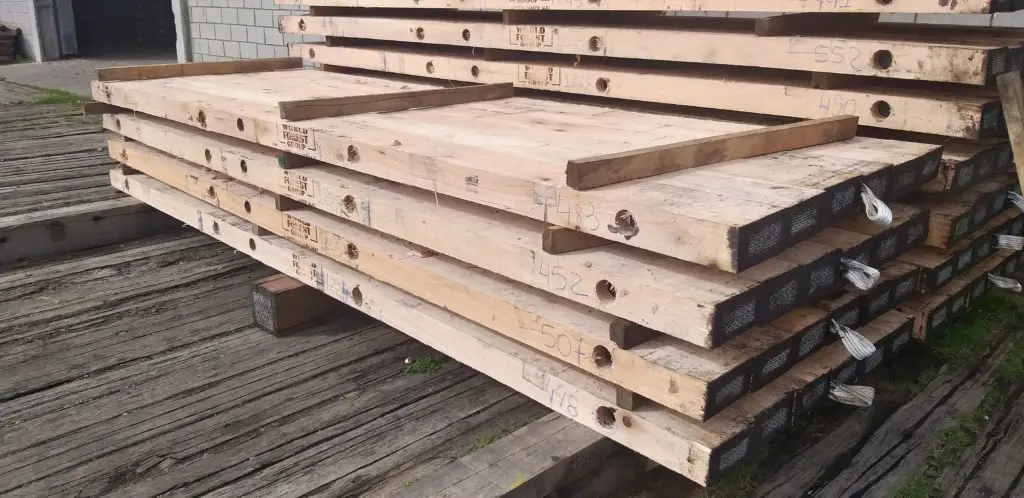
14’x4’x4” Eucalyptus mats fresh off the line. Straps are for easy unloading.
The Problem: Freight, Fiber, And Fit
Prior to President Trump’s second term, the infrastructure business had shifted toward transmission lines and smaller pipelines, often with lighter cranes and equipment than large mainline pipeline spreads. In many of these applications, ground conditions and equipment loads do not always demand the thickest, heaviest mats.
Even now on the eve of 2026, with large diameter pipeline construction there is a place for the principle of a thinner mat. The principle is to use strength to determine mat thickness and work from there.
In the case of a thinner mat, Eucalyptus timber mats can help because contractors are squeezed by:
- High diesel costs and volatile fuel surcharges.
- Flatbed rates at or near historic highs.
- Hardwood mills switching to softwood and lower‑quality logs.
- Difficulty sourcing consistent, high‑strength mixed hardwood for mats.
In that world, a thinner mat that still meets strength requirements looks attractive. It promises more mats per truck, lower freight per mat, and potentially lower Total Cost of Ownership (TCO) if it also lasts.
The Question: Is A Thinner Mat Enough?
Assume your equipment loads, ground conditions, and safety factors genuinely support a thinner mat. A thinner mat will almost always reduce transport cost because you can load more mats per truck, especially when the fiber is lighter for its strength.
The key question is whether freight savings alone are enough to justify the change. If thinner mats are built from weaker species or to loose tolerances, you might save on trucking and lose on lifespan, failures, or both.
This is where a Total Cost of Ownership view matters: purchase + freight + lifespan + failure risk. For a general explanation of how TCO works in construction and asset decisions, see this overview of what Total Cost of Ownership means in construction.
With a TCO analysis, you can decide ourself if a thinner mat is the future of matting.
The Answer: Yes, If Strength Comes First
Yes, thinner mats can do the job—if they are engineered around strength and quality, not just dimension and price. Dimension by itself is a poor predictor of performance; strength and consistent manufacturing are much better predictors of how a mat behaves in real loads.
A few practical rules of thumb:
- Start with the loads and soil conditions you actually face, not just legacy mat thickness.
- Specify minimum bending and shear strength, not just thickness and species name.
- Require tight manufacturing tolerances so mats behave consistently and stack safely.
The Strength Adjusted analysis explains how to estimate required bending and shear strength, then choose the right thickness and species, instead of defaulting to “the way we have always done it.”
Why Eucalyptus Works: A Thinner Mat Is the Future of Matting
Eucalyptus timber is significantly stronger than typical mixed hardwood blends used in many mats. World Forest Group data and independent coverage show Eucalyptus can be about 40% stronger than oak and roughly 100–300% stronger than some mixed hardwood combinations, depending on the comparison set.
That strength unlocks thinner, lighter mats that still meet or exceed the demands of many T‑line and smaller pipeline jobs:
Because Eucalyptus is roughly 40% stronger than oak in bending, a 4‑inch Eucalyptus mat can deliver similar bending strength as a 4.75‑inch oak mat.
Eucalyptus is also lighter for its strength, which means more mats per truck without sacrificing performance.
In practical terms, contractors have seen:
About 50+ 14′ x 4′ x 4″ Eucalyptus mats per truck on average over mat lifetime, even accounting for wear and damage.
Better standardization where “every mat is the same” improves safety and predictability on site.
The Eucalyptus timber mats essentials page walks through why one species, tight tolerances, and plantation fiber make this type of thinner mat both strong and repeatable.
Coming in PART II: How to use Total Cost of Ownership to Evaluate a Thinner Mat.

