
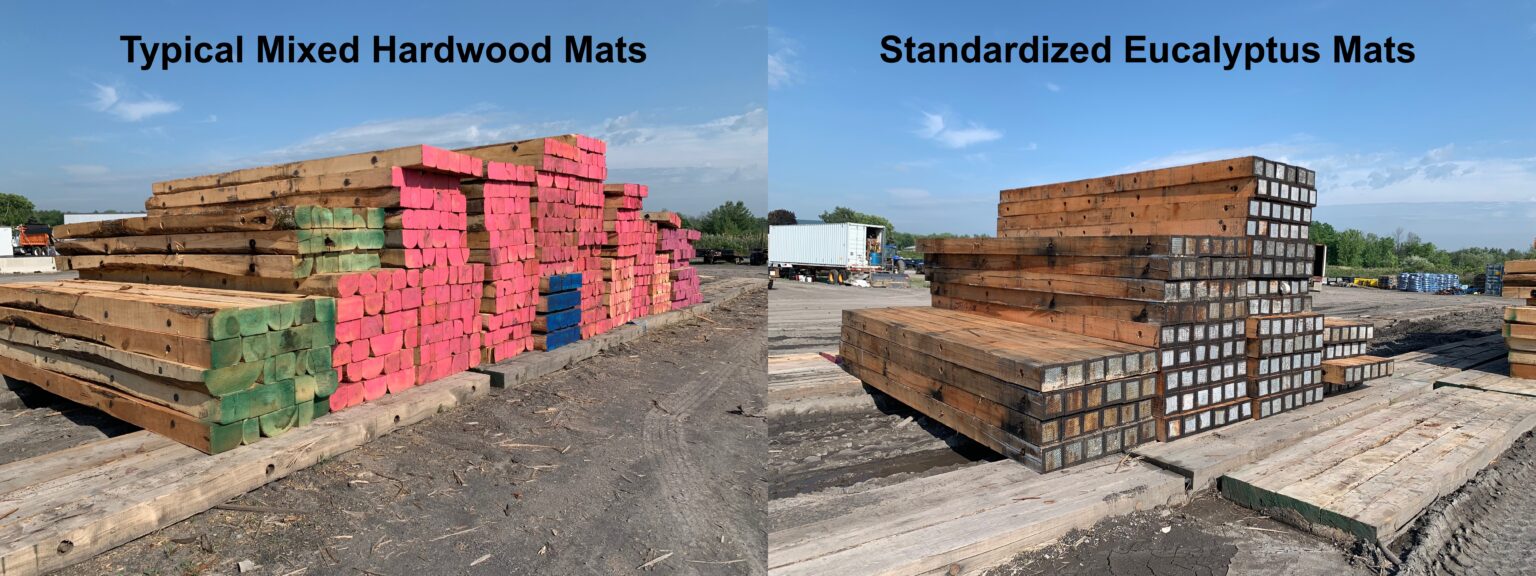
Why Timber Mat Standardization Matters For Ground Protection Equipment
Do Standards and Standardization Matter in a Hardwood Timber Mat? – was revised on January 08, 2026
Key Takeaways:
Timber mat standardization reduces project costs through predictable performance and reduced field failures
Material strength varies dramatically between species, with Eucalyptus delivering 2-4x the bending strength of mixed hardwood alternatives
Standardized production processes eliminate the variability that creates reliability problems and increases total cost of ownership
Timber mat standardization directly impacts project success and cost control. Contractors need ground protection equipment that performs predictably under heavy machinery. However, the timber mat industry operates with minimal standards beyond basic dimensions. Understanding standards matters helps equipment managers make better purchasing decisions that reduce risk and lower costs.
What Standardization Means
Standards establish consistent specifications that buyers and suppliers can rely on. A standard represents something established by authority, custom, or general consent as a model or example. Therefore, timber mat standardization means bringing products to established specifications for size, weight, quality, and strength.
Standards increase reliability, decrease costs, increase safety, and simplify operations. For example, imagine homes without electrical standards. We wouldn’t know if power came at 120 volts, 240 volts, 80 volts, or 150 volts. Appliances would burn out or fail to run efficiently. Consequently, everyone would complain constantly. Same with gasoline and octane. Our engines would burn out.
That’s where the timber mat industry stands today: almost no standards beyond dimensions.
Current Status: The Basics Only
The timber mat industry agrees on two basic standards. First, dimensional specifications provide consistency. When contractors order an 18′ x 8″ x 4′ mat, they receive something close to those dimensions. Second, visible rot disqualifies mats from use. These represent the lowest common denominator for timber mat standardization.
However, timber mat standardization typically stops there. Four factors explain this limitation:
Mixed hardwood mats contain multiple species with different working characteristics
Smaller diameter logs show greater variability than older growth timber
The industry lacks a central organization for establishing guidelines
Traditional standardization methods prove too costly for current business models
Why Standardization Remains Difficult
Mixed species mats inherently resist timber mat standardization. Each species delivers different density, strength, and durability characteristics. Additionally, smaller logs from younger trees show more variability than older growth timber. This inconsistency makes engineering calculations difficult and increases failure risk.
The timber mat industry also lacks a central trade organization to develop and enforce standards. The obvious exception is the North American Matting Association (NAMA). But, NAMA isn’t an enforcement agency. It does provide a Technical Standard for Wood Mats. Without coordinating authority, suppliers compete on price rather than performance specifications.
Material Strength Variations Demand Standardization
Material properties vary dramatically across common mat timber species. These differences directly affect load capacity, service life, and safety margins. Understanding these variations explains why timber mat standardization matters for project planning:
| Wood | Bending (psi) | Shear (psi) | Compression (psi) |
|---|---|---|---|
| Eucalyptus | 2000 | 265 | 970 |
| Mixed Hardwood #1 timbers | 1000 | 200 | 415 |
| Mixed Hardwood #2 timbers | 550 | 200 | 415 |
Source: American Wood Council National Design Specification (AWC NDS) for Wood Construction.
AWC NDS, Australian Standard 3818.7
Eucalyptus demonstrates 2000 PSI bending strength versus 1000 PSI for Mixed Hardwood #1 grade. Mixed Hardwood #2 grade drops to 550 PSI. This dramatic variation shows how timber grade affects structural performance even within the same species category. Shear and compression strength follow similar patterns.
These differences matter for engineering calculations. Contractors specifying mixed hardwood mats must account for unknown timber grades and species variations. This uncertainty should force conservative designs with extra material. It doesn’t. Almost every mat user complains about rot, real dimensions vs. nominal dimensions, etc. Timber mat standardization should allow precise specifications based on known properties.
How Standardization Reduces Costs
Predictable performance characteristics lower total project costs through several mechanisms. First, engineers can specify thinner profiles when material properties are known. For example, a 6.75-inch Eucalyptus mat provides equivalent bending strength to a Select timber 8-inch mixed oak mat. Or, about equivalent to a 12″ #2 timber. This optimization reduces material costs and freight expenses.
Second, mat standardization eliminates field failures caused by material variability. Equipment operators work more confidently knowing mats will perform predictably. Ground crews handle fewer emergency replacements. Project managers experience fewer delays caused by mat performance issues.
Third, standardized specifications simplify logistics planning and inventory management. Contractors can calculate exact quantities needed without safety margins for unknown performance. This precision reduces carrying costs and working capital requirements.
Two Paths To Standardization
Industry standardization typically occurs through two approaches. First: Top-down standardization happens when trade organizations develop mandatory specifications. This approach works well in mature industries with strong associations. But, the timber mat industry lacks such coordinating authority.
Second: Bottom-up standardization emerges organically through free market forces. Suppliers offering superior products attract customers seeking better performance. Competitors then match or exceed those standards to maintain market share. This approach takes longer but creates lasting change driven by customer demand.
World Forest Group pursues both the association and the free market approach to mat standardization. The company provides reduced risk, lower cost, uniform products that demonstrate the benefits of standardization. This strategy takes the long view but drives sustainable industry improvement.
Eucalyptus Timber Mats Demonstrate Standardization Benefits
Eucalyptus timber mats deliver standardization through uniform raw material, single-facility production, and consistent grading standards. Every mat uses the same species with known density and strength characteristics. Additionally, standardized manufacturing processes ensure dimensional consistency and quality control.
Moreover, procurement standards prohibit wane and rot throughout the mat. This elimination of common defects increases reliability and service life. As a result, every Eucalyptus mat performs predictably regardless of production date or batch.
In contrast, mixed hardwood mats vary significantly based on species composition, timber grade, and log source. Each mat performs differently under load. This variability increases risk for contractors and complicates engineering calculations. Consequently, mixed hardwood approaches deliver lower reliability and higher total costs.
Standardization As Industry Evolution
Standardization represents the logical next step for the industry. Contractors increasingly demand predictable performance and lower total cost of ownership. Standardized products like Eucalyptus mats and Southern Red Oak alternatives meet these requirements. Meanwhile, mixed species approaches remain stuck at the lowest common denominator.
The free market will ultimately drive timber mat standardization as customers choose suppliers offering superior consistency. This evolution mirrors other industries where standardization delivered massive quality and cost improvements. Therefore, forward-thinking contractors should evaluate suppliers based on standardization capabilities, not just dimensional specifications.
World Forest Group works to lead this industry evolution toward timber mat standardization. The company believes contractors deserve ground protection equipment with predictable performance characteristics. This commitment to standardization reduces project risk while lowering costs.
Ready to learn more about timber mat standardization and predictable ground protection solutions? See the Resources for additional articles. Explore the basics of Eucalyptus timber mats at to understand how standardization delivers project benefits. Contact World Forest Group to discuss how standardized products support your specific requirements.

